


Last Updated: February 2026
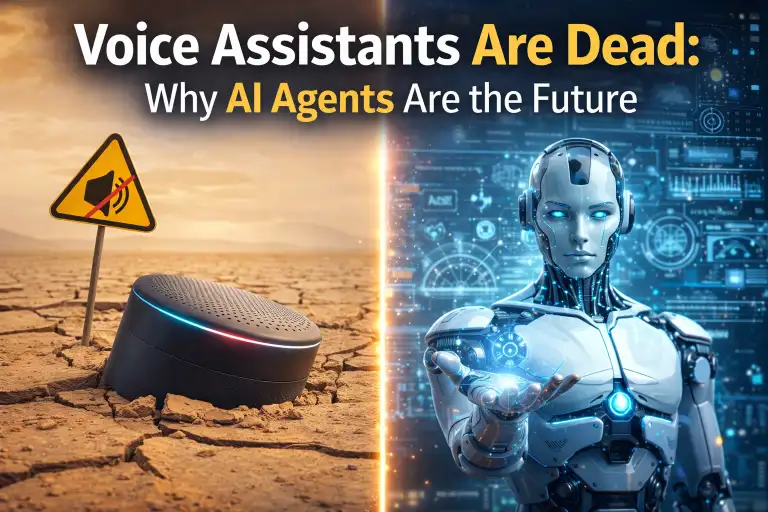
Remember when voice assistants were the future? “Alexa, turn off the lights.” “Hey Google, what’s the weather?” We all thought we’d be living in a Star Trek world by now, casually chatting with our homes about everything.
Instead, we got devices that mishear every third request, can’t handle two-step commands, and need specific phrasing to do anything useful. Voice assistants promised us conversational AI but delivered glorified kitchen timers.
But something better has quietly emerged: AI agents. And they’re changing everything about how we interact with technology.
What Went Wrong with Voice Assistants
Voice assistants hit the market with massive hype. Amazon, Google, and Apple poured billions into smart speakers, promising a hands-free future. And for a while, it seemed like they delivered.
But the honeymoon ended fast. Here’s what actually happens when you use a voice assistant in 2026:
- Rigid command structures — Say it wrong, and nothing happens
- No context awareness — Every request starts from zero
- Limited integrations — Only works with “approved” apps and services
- Privacy concerns — Always listening, always sending data somewhere
- No real intelligence — Can’t reason, can’t plan, can’t adapt
Most people use their Echo or Google Home for three things: timers, weather, and music. That’s a lot of technology for a kitchen timer that occasionally plays Spotify.
Enter AI Agents: What Voice Assistants Should Have Been
AI agents are fundamentally different. Instead of waiting for a specific command, they understand context, take initiative, and actually do things on your behalf.
Here’s the difference:
Voice Assistant: “Alexa, remind me to email John tomorrow at 9 AM.”
Result: You get a reminder. Then you still have to write and send the email yourself.
AI Agent: “Remind me to follow up with John about the project proposal.”
Result: The agent checks your recent emails with John, drafts an appropriate follow-up based on your communication history, and either sends it or asks for your approval first.
That’s not a minor upgrade—it’s a completely different paradigm.
5 Things AI Agents Can Do That Voice Assistants Can’t
1. Chain Complex Tasks Together
Voice assistants handle one command at a time. AI agents can execute multi-step workflows:
- “Research flights to Tokyo for next month, find the best deals, cross-reference with my calendar for conflicts, and send me a summary”
- The agent searches multiple sites, checks your schedule, compiles options, and delivers a digestible report
2. Remember Context Across Conversations
Tell Alexa something today, and tomorrow it’s forgotten. AI agents maintain memory:
- They remember your preferences, past decisions, and ongoing projects
- No need to repeat yourself or re-explain context every time
3. Actually Use Your Computer and Phone
Voice assistants are trapped in their own ecosystem. AI agents can interact with virtually any application:
- Browse the web and extract information
- Write and edit documents
- Manage files and organize data
- Control other applications through automation
4. Learn Your Preferences Over Time
The more you work with an AI agent, the better it understands you:
- Your communication style
- How you like information presented
- Which tasks you prefer to handle yourself vs. delegate
5. Make Decisions Within Boundaries You Set
AI agents can operate with varying levels of autonomy:
- “Always ask before sending emails” vs. “Handle routine responses yourself”
- You control how much independence the agent has
Real-World AI Agent Examples
AI agents aren’t theoretical—they’re here now:
- OpenClaw — A self-hosted AI assistant that connects to your services and automates tasks across platforms
- ChatGPT with Plugins/Actions — Can browse the web, execute code, and integrate with external services
- Claude with Computer Use — Anthropic’s agent that can directly control desktop applications
- AutoGPT and similar tools — Autonomous agents that break down goals into actionable steps
If you’re curious about which AI model to choose as the “brain” for an agent, check out our comparison of ChatGPT, Claude, and Gemini.
Self-Hosted vs. Cloud AI Agents
One of the biggest advantages of AI agents over voice assistants: you can actually run them yourself.
| Factor | Cloud AI (ChatGPT, etc.) | Self-Hosted (OpenClaw, etc.) |
|---|---|---|
| Privacy | Data goes to company servers | Stays on your hardware |
| Customization | Limited to what they offer | Fully configurable |
| Cost | Monthly subscription | API costs (often cheaper) |
| Reliability | Depends on their uptime | You control it |
| Integration | Walled garden | Connect to anything |
For a deeper dive into self-hosting benefits, see 10 OpenClaw Features That Make Self-Hosting Worth It.
What About Smart Home Control?
Here’s where it gets interesting. Voice assistants’ strongest use case has been smart home control. But AI agents are better at this too.
Traditional approach: Rigid automations + voice commands
AI agent approach: Intelligent automation that adapts
An AI agent can:
- Notice patterns in your behavior and suggest automations
- Adjust settings based on context (weather, calendar, who’s home)
- Handle complex scenarios that would require dozens of traditional automations
- Explain what it did and why
We compared the approaches in OpenClaw vs Home Assistant: Which Should Run Your Smart Home?
Are Voice Assistants Completely Dead?
Not entirely. They still have their place:
- Quick, simple commands — “Set a timer for 10 minutes” still works fine
- Hands-free situations — Cooking, driving, etc.
- Kids and accessibility — Simple interface for everyone
But for anything requiring actual intelligence—reasoning, planning, multi-step tasks—voice assistants are being left behind. The future isn’t talking to a cylinder that says “Sorry, I don’t understand.” It’s having an AI partner that actually helps.
How to Get Started with AI Agents
Ready to upgrade from voice commands to AI agents? Here’s how to start:
- Try cloud-based options first — ChatGPT Plus, Claude Pro, or Gemini Advanced give you agent capabilities without setup
- Identify repetitive tasks — What do you do repeatedly that an agent could handle?
- Consider self-hosting — For privacy and customization, OpenClaw is a great starting point
- Start small — Let the agent handle one workflow before expanding
The Bottom Line
Voice assistants were a stepping stone—a limited preview of what AI interaction could be. AI agents are the destination.
They don’t just respond to commands. They understand context, remember history, take action across platforms, and actually make your life easier. That’s not incremental improvement—that’s a paradigm shift.
Your Echo can stay in the kitchen for timers. For everything else, it’s time to meet your AI agent.
FAQ
Are AI agents more expensive than voice assistants?
It depends on your usage. Voice assistants like Alexa and Google Home are free after the hardware purchase. AI agents typically involve API costs (like ChatGPT subscriptions or pay-per-use APIs). However, self-hosted options like OpenClaw let you control costs by choosing which AI model to use and when.
Can AI agents control my smart home devices?
Yes—and often better than voice assistants. AI agents can integrate with platforms like Home Assistant and control devices through natural conversation. They can also create intelligent automations based on context rather than rigid triggers.
Do I need technical skills to use an AI agent?
For cloud-based agents like ChatGPT or Claude, no technical skills are required. Self-hosted options like OpenClaw require some setup but have gotten much easier with modern installation tools.
Are AI agents always listening like voice assistants?
Unlike voice assistants, most AI agents only activate when you explicitly interact with them. Self-hosted agents never send data to external servers unless you configure them to, giving you complete privacy control.
Will voice assistants disappear completely?
Probably not—they’ll likely evolve to incorporate AI agent capabilities. Amazon and Google are already adding LLM features to Alexa and Google Assistant. But the standalone “smart speaker” era is ending.
Affiliate Disclosure: SimpleLifeSaver.com may earn a commission from purchases made through links in this article at no extra cost to you. We only recommend products and services we genuinely believe in.